Quakers have been meeting in Nottingham since the 1600s. Here is a pictorial history of the Meeting Houses that have been in existence since then. The original, more detailed photo album was compiled by the late John Gray, and is available to view after Meeting for Worship.
Every effort has been made to acknowledge copyright for the photos. Please inform us of any omissions so we can rectify them as soon as possible.
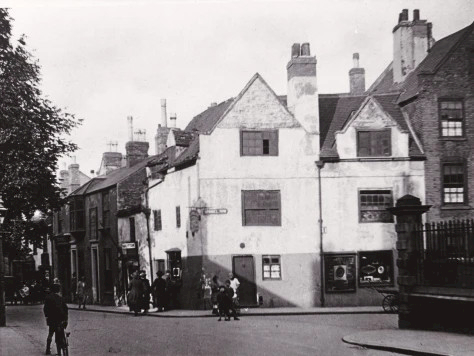
In 1649, George Fox (a key founding member of the Religious Society of Friends, or Quakers) came to Nottingham with Friends to attend a meeting. While here, he interrupted a service at St Mary’s Church, for which he was imprisoned; this was the first of his eight documented imprisonments for his faith. In Nottingham, he was held at Weekday Cross, which he described as ‘a nasty, stinking place’. Hannah Reckless, the wife of the Sheriff of Nottingham, John Reckless, was present at St Mary’s during the interruption and was so influenced by Fox’s testimony that she arranged for him to be moved from the gaol into custody at the Sheriff’s house. Both she and her husband became Quakers soon afterwards.
(Photo taken c. 1905. Historical material by J Holland Walker, quoted from picturethepast.org.uk).
1678-1737: Spaniel Lane
John Reckless’s house. (Photo taken c. 1920 just before demolition. Photo: courtesy of www.picturethepast.org.uk)
Indenture for the sale of a new house and garden in Spaniel Lane (now Spaniel Row) from John Reckless to Friends for £10.
1737-1847: Spaniel Row
Two houses adjacent to the existing one in Spaniel Row were bought for £36, and a new Meeting House built on the site at a cost of £337. During the building period, Friends met in a room on Wheeler Gate lent by David Reckless. (Drawing c 1847) (Image © Religious Society of Friends (Quakers) in Britain)
A 3D drawing of how the Spaniel Row Meeting House might have looked. (Drawing by John Gray)
North wall showing original pointed windows – an unusual design feature for a Meeting House. (Photo: 1951 during demolition)
Interior with added ‘chapel’ entrance on left. After the building was sold, a chapel-like frontage was added by the Catholic Apostolic Church. (Photo: 1951 during demolition)
1847-1961: Friar Lane
Friar Lane Meeting House built at a cost of £1600, on the Friar Lane Burial Ground which had been in use since 1804. This picture shows the original entrance, before the widening of Friar Lane in 1926.
New entrance after widening of Friar Lane.
Interior showing ministers’ gallery and front bench where the Elders set. Several original benches are in the present building. (Photo: courtesy of George L Roberts and www.picturethepast.org.uk)
Friar Lane Meeting House with the Adult School Rooms on the right.
Adult School Rooms, Friar Lane on the right. In 1798, a literacy school for adults was started by William Singleton of the Methodist New Connection Church. He was later assisted by a Quaker, Samuel Fox, who took it over and it became known as the Quaker School. Friends raised the money for these purpose-built premises. Caroline Howitt and Alice Scanlon started the Women’s Adult School, the first one in the country. The Adult School movement grew and spread nationwide. (Photo: courtesy of George L Roberts and www.picturethepast.org.uk)
1961-present: Clarendon Street
Clarendon Street Meeting House. Built for £30,000 on an unused part of the Clarendon Street burial ground.
Interior of the Meeting Room with its original domed roof.
The building was awarded a RIBA Architecture Medal in 1961.
The Burial Ground’s original layout with its memorial stones.
The Burial Ground was landscaped and new paths laid in 1994. The memorial stones were moved from the central grassed area to make a safer recreational area for the children.
The original domed roof from the outside, which by 2006 was deteriorating.
A crane is used during the replacement of the roof.
The Meeting House as it is today, with its new roof.
The ceiling of the new roof incorporates a heat exchanger and has solved the acoustics problem which the previous domed construction caused.
The Meeting House roof in 2016, complete with solar panels.
The Peace Pole was carved for the Week for Peace festival in 2014. Above the dove carving is the message ‘May peace prevail on earth’ in several languages.
The sign welcoming people to the Meeting House.
For more information on general Quaker history please see the links the 'About Quakers' Links below